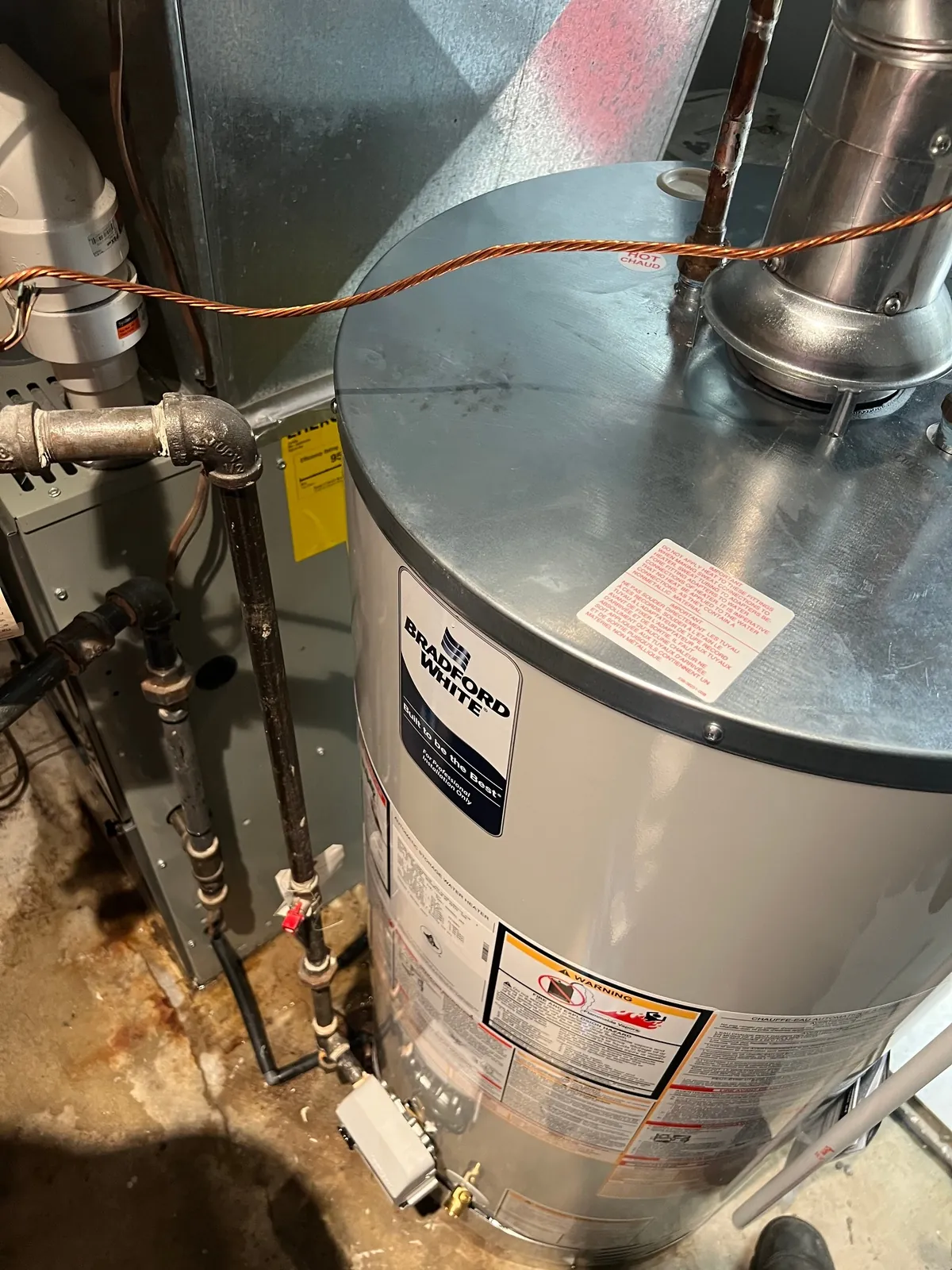
The short version
- Shut the cold water valve on top of the tank, then turn the gas control to off or switch off the breaker. Those two moves stop most of the damage.
- Dry everything and watch where the water comes back. Leaks at the fittings, the drain valve or the relief valve can usually be repaired.
- Water pooling under the tank with nothing wet above it means the steel has corroded through. No repair holds that, and the failure can be sudden.
- Replacement tanks are on our pricing list, starting at $1,950 + HST for a 50 gallon conventional vent unit, and same-day swaps are normal.
Stop the water and the fuel first
Two valves stop most of the damage. Find them before you start working out the cause.
- Shut off the cold water. There is a valve on the cold pipe going into the top of the tank. Turn the handle clockwise until it stops, or push the lever across. If it is seized, shut off the main water valve for the house instead.
- Shut off the fuel. On a gas tank, turn the control dial on the front to the off position. On an electric tank, switch off its breaker at the panel. Do this even if the leak looks small.
- Get the water away from the tank. Towels, a wet vacuum, a shallow pan. Lift anything stored nearby off the floor, especially cardboard and anything with a plug on it.
- Then find the source. Dry the top of the tank, the pipes and the floor around the base. Wait a few minutes and watch where the water comes back.
If you smell gas, stop and leave
Get everyone out, do not touch any switch, and call the Enbridge Gas 24 hour emergency line on 1-866-763-5427 from outside. The gas comes first. The tank can wait until the building is safe.
Do not leave a leaking tank heating. A gas or electric element firing into a tank that is losing water is how a small problem turns into a cracked tank or a scald risk.
Where the leak is tells you what it is
Almost every hot water tank leak is one of five things, and you can narrow it down in a few minutes. Work from the top down, because water runs.
| Where the water shows up | What it usually is | Repair or replace |
|---|---|---|
| Top of the tank, around the pipes | A loose or corroded water connection | Usually a repair |
| A pipe on the side, dripping or running | The relief valve letting water out | A repair, but find out why it opened |
| The small tap low on the front | The drain valve, loose or worn | Usually a new valve |
| Pooling under the tank, nothing wet above it | The tank itself has rusted through | Replace the tank |
| Slightly damp in humid weather, no steady drip | Condensation on a cold tank | Nothing to fix |
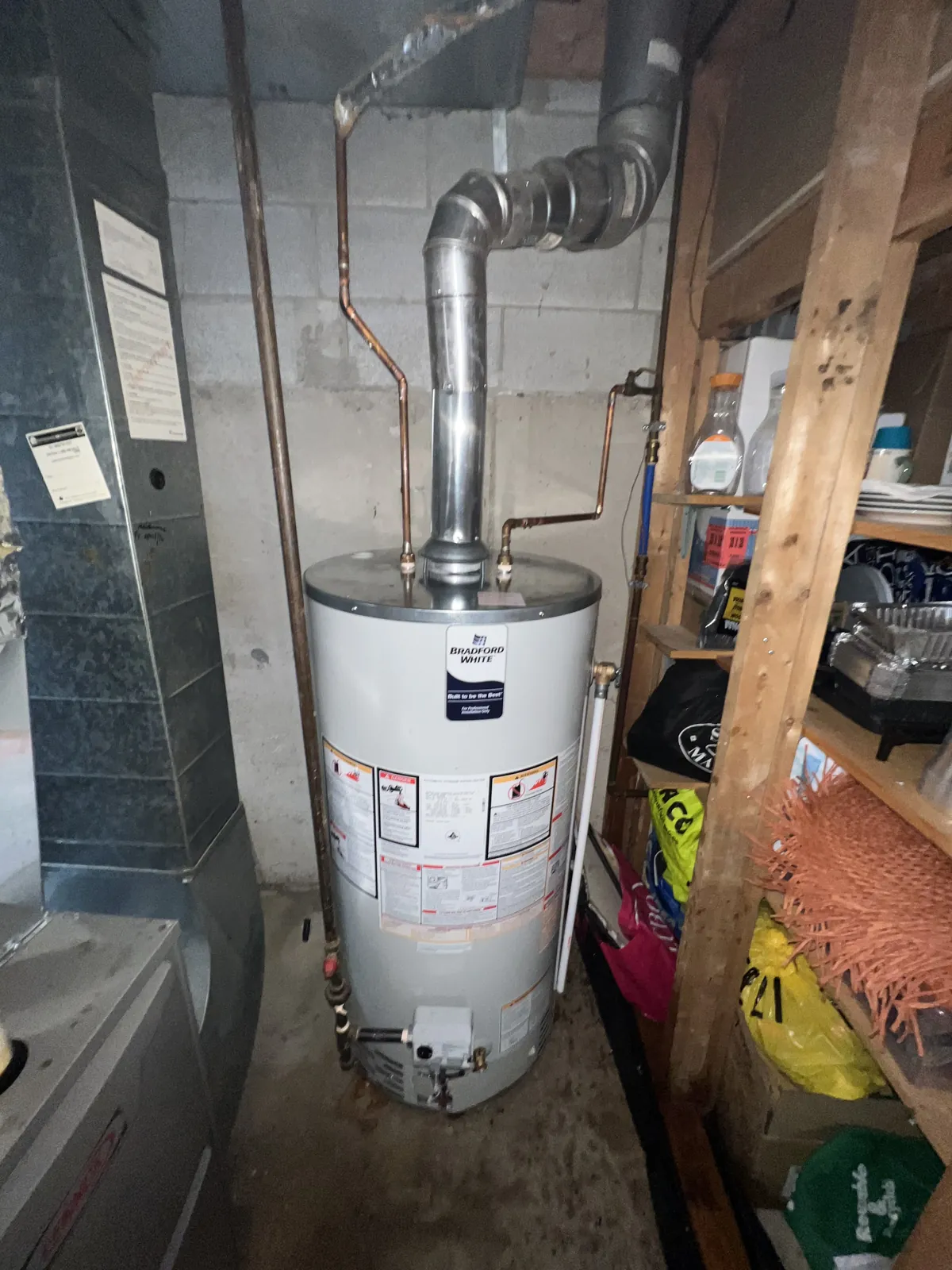
A leak that only shows at the base, with dry pipes and a dry top, is the bad one. The steel shell has corroded from the inside and water is finding its way out under the jacket. That is what people mean by a water heater leaking from bottom, and it is not patchable.
Never plug the relief valve
The valve near the top or on the side of the tank, with a pipe running down from it, is the temperature and pressure relief valve. It is a safety device. If it is letting water go, it is either faulty or it is doing its job because something else is wrong.
- The water temperature is set too high.
- The water pressure in the house is too high, often where a pressure reducing valve or a backflow device stops heated water expanding back into the city main.
- The valve itself is worn or has been opened too many times.
Whichever it is, never cap that pipe or plug the valve. Its whole job is to let pressure out of a sealed steel tank. Blocking it is dangerous. Get the cause found instead: a new valve, a lower temperature setting, or an expansion tank on the cold line.
Can you keep using it while it leaks
It depends on what is leaking, and the honest answer for most people is no, not for long.
- A weeping fitting or a dripping drain valve. You can usually keep the hot water on for a day or two while a repair is booked, as long as you can see where the water is going and it is not reaching anything electrical.
- A relief valve discharging. Shut the tank down. Something is driving temperature or pressure past the safe limit and that needs sorting out before the tank is heating again.
- Water from under the tank. Shut it down and plan on replacing it. A rusted tank can go from a trickle to a hundred and more litres on the floor without warning.
One more reason to switch a gas tank off rather than nurse it. The burner and the gas control sit at the bottom, right where water pools. A gas control that has sat in water gets replaced, not dried out and reused: the parts inside are built to tolerances that silt and corrosion ruin. Safety regulators have said so for years.
If the tank has to go
A straight swap for the same capacity and vent type is a short job. We publish installed prices rather than ranges, so you can see the number before you call.
On the pricing list, a conventional vent tank runs from $1,950 + HST for a 50 gallon unit to $2,350 + HST for a 60 gallon. Power vented tanks start at $2,250 + HST for 50 gallons and go to $3,500 + HST for 75. A tankless unit starts at $3,750 + HST, and financing is available from $42 a month on qualifying installs.
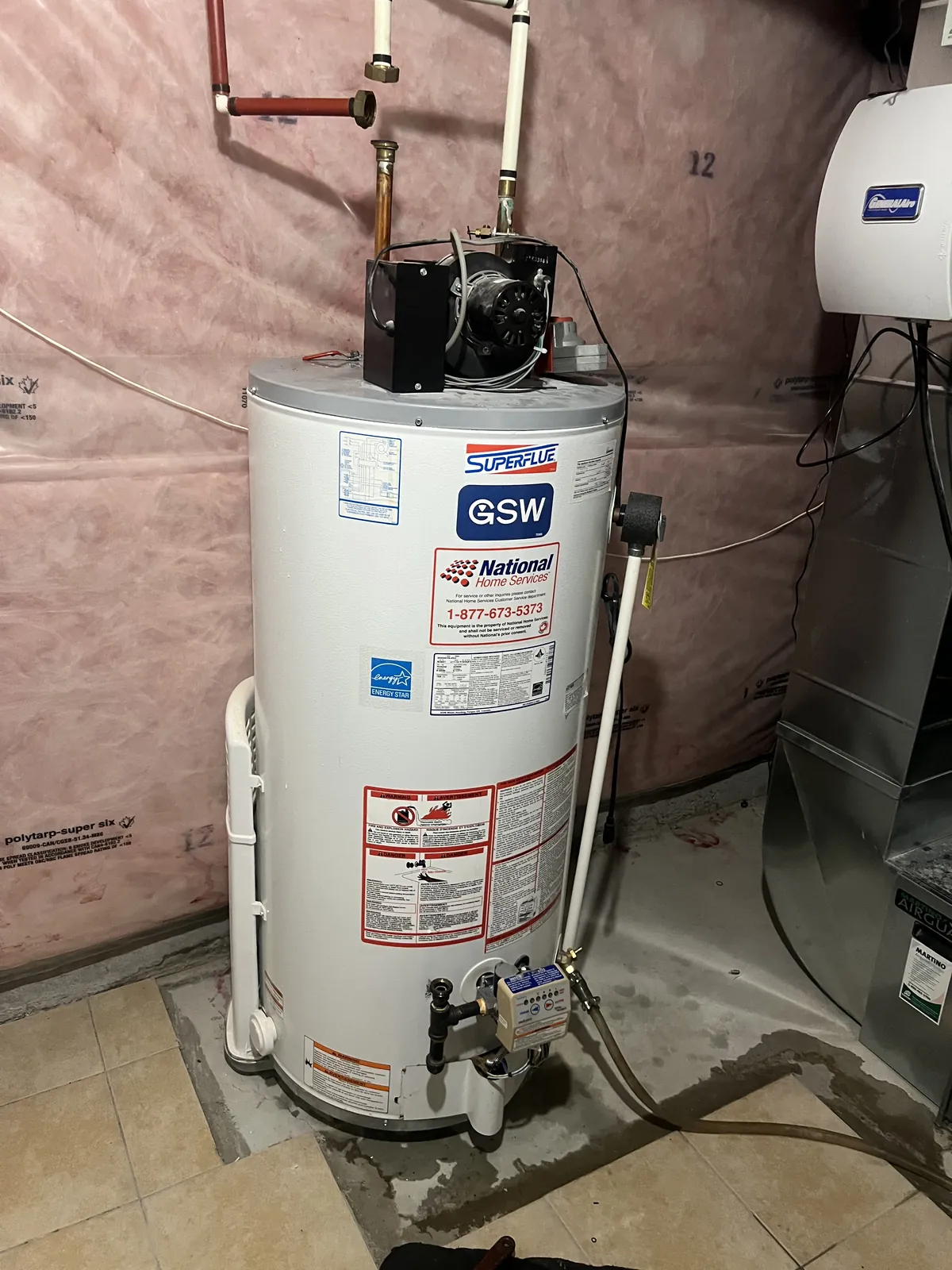
- Changing capacity or vent type is fine, but it changes the venting, the gas line or the electrical, and that gets priced and explained before anything starts.
- If your tank is rented, call the rental company first. It is their equipment and their agreement, and the buyout terms matter. There is more on that in our guide to renting or buying a water heater.
- Photograph the tank, the puddle and anything damaged before it is cleaned up. Your insurer will ask.
- Worth knowing the age: the date is coded into the serial number on the rating plate. Our guide on how long a hot water tank lasts explains how to read it.
If the leak is at a fitting or a valve, tank water heater repair is the cheaper answer and we will say so. If the tank is finished, we will say that too. Calls are answered at any hour, and a tank leaking into a finished basement is treated as an emergency water heater call.