The short version
- Once a year is the right interval for a gas furnace, and early autumn is the quiet time to book it.
- Five jobs are yours: the filter, the vents, the thermostat, the space around the furnace, and a test run before you need the heat.
- The rest needs a licensed technician, because it involves the heat exchanger, the burners, gas pressure and the venting.
- Ontario now wants a carbon monoxide alarm on every storey of a house with a gas appliance, not only outside the bedrooms.
Why a gas furnace needs a look every year
A furnace runs for months with nobody opening it. Dust builds up, parts wear, and the failure that follows tends to arrive on the coldest night of the year. Most of what an annual visit does is catch cheap problems while they are still cheap.
The other half of it is safety. A gas furnace burns fuel inside a metal heat exchanger and sends the exhaust outside through a vent. If that exchanger cracks or the vent blocks, combustion gases can reach the air in the house. Carbon monoxide has no smell and no colour, and a crack is not visible without an inspection.
The carbon monoxide alarm rule changed this year
Ontario requires a working carbon monoxide alarm next to every sleeping area in a home with a fuel-burning appliance. Since 1 January 2026 the Fire Code also asks for one on every storey, including storeys with no bedrooms. The rules are set out on the province's carbon monoxide page.
There is a paperwork reason too. Manufacturers expect the equipment to be maintained, and a parts warranty claim can be refused on a furnace that has never been serviced. Keep the report from each visit.
Five things you can do yourself
- Change the filter. A one inch filter wants doing every one to three months. A four or five inch media filter usually runs six to twelve months. Pets, dust and renovation work shorten all of those. The arrow on the frame points towards the furnace.
- Open the vents and walk the house. Supply vents shut in spare rooms or blocked by a couch make the rest of the house harder to heat and push up the pressure in the ducts.
- Check the thermostat. Fresh batteries if it takes them, and switch it to heat on a mild day rather than on the first cold night.
- Clear the space around the furnace. Nothing stacked against the cabinet, nothing covering the return, and no paint or solvent stored nearby. The furnace needs air, and chemicals near a burner are a bad mix.
- Run it in September. Turn the heat up ten degrees for fifteen minutes. If it does not light, or it lights and shuts off again, you have found it now instead of in January.
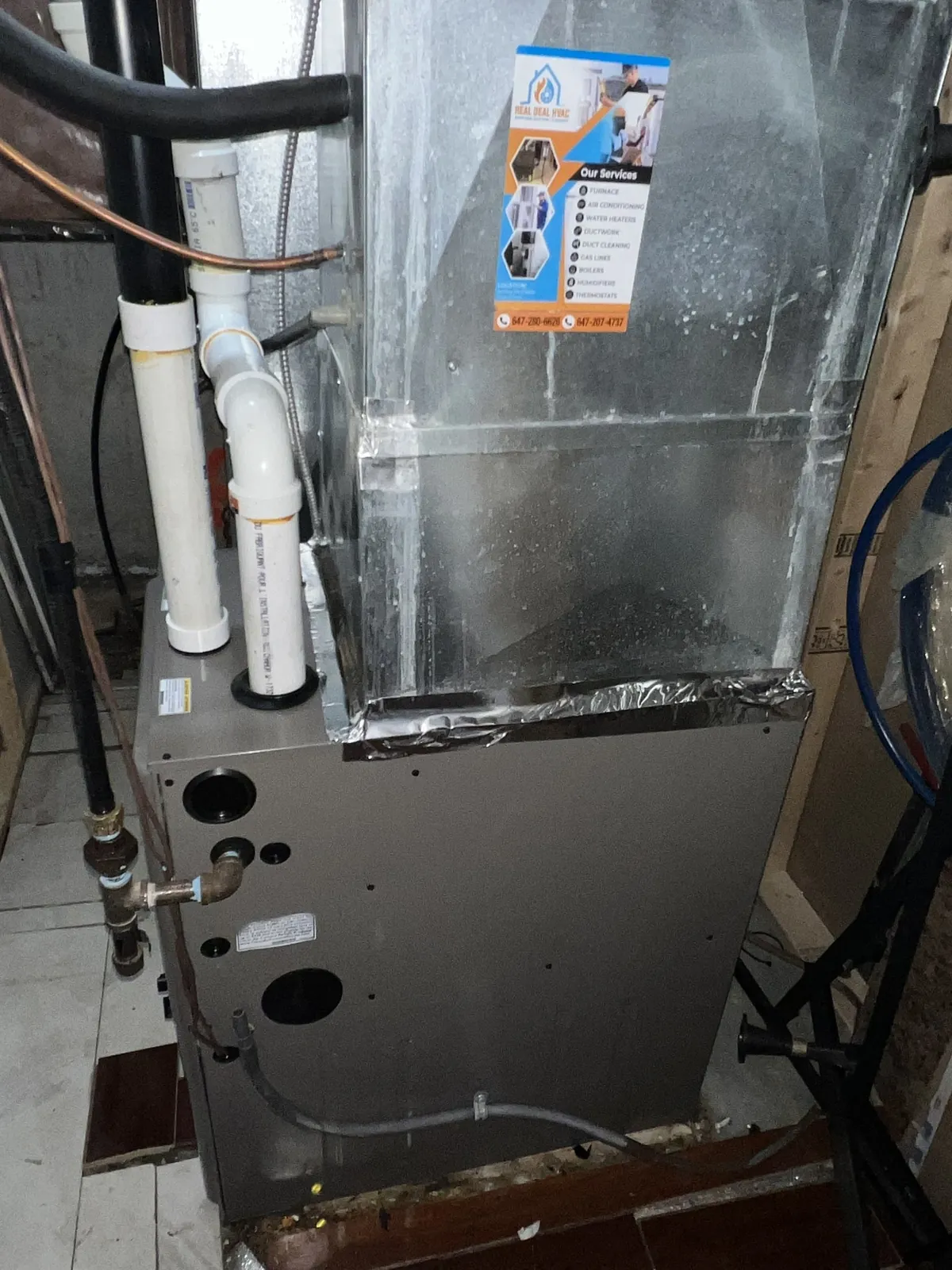
That is the whole homeowner list. Nothing on it means opening the burner compartment or touching anything on the gas side.
What a professional furnace tune-up covers
The rest of the job needs instruments and a licence. This is what an annual furnace tune-up looks at, and why each item is on the list.
| What gets checked | Why it matters |
|---|---|
| Heat exchanger | A crack can let combustion gases into the air you breathe. It is the most important item on the list and it cannot be ruled out from the outside. |
| Burners and flame sensor | Soot upsets the flame. A coated sensor cannot confirm the burner lit, so the furnace fires for a few seconds and shuts down again. |
| Gas pressure | Measured against the manufacturer's spec. Too high or too low and the furnace burns badly. |
| Venting | Corrosion, blockage and slope on the vent pipe, plus the condensate drain on a high efficiency unit. |
| Blower and temperature rise | Measured across the furnace and compared with the rating plate. Out of range points at airflow, usually a filter, a duct or a dirty blower wheel. |
| Electrical and safeties | Connections tightened, motor current compared with the rating, and every limit and shutoff tested. |
You should also come away knowing what is fine, what is wearing and what needs attention. Anything found gets quoted on its own and confirmed before it is carried out.
Furnace cleaning and duct cleaning are two different jobs
People search for furnace cleaning and mean one of two things. A tune-up cleans the parts inside the furnace: the burners, the sensor and the blower. Cleaning the ducts is separate work on the sheet metal around it.
Most houses want the first one every year and the second one rarely. Renovation dust, a house you have just moved into, or something visible in the vents are the reasons to do the ducts. A whole system duct cleaning is $475 + HST on the pricing list, and it is a job to book when there is a reason, not on a yearly habit.
When to stop and call someone
Some of what a furnace does is not a maintenance item. These are the ones to act on.
- You smell gas. Leave the house, do not touch switches, and call from outside. Enbridge answers a gas emergency line at 1-866-763-5427 around the clock. A licensed gas fitter finds and repairs the leak once the utility has made the house safe.
- A carbon monoxide alarm sounds. Get everyone outside and call 911. Have the fuel-burning appliances checked before the heat goes back on.
- It lights and shuts off, over and over. Something is telling the furnace to stop. Repeated lockouts are a fault, not a quirk to live with.
- Soot, rust flakes or water sitting at the base. All three mean the cabinet needs opening by someone who can read what they find.
- No heat at all. Check the thermostat, the breaker and the switch on the furnace itself, then call. Furnace repair is answered 24 hours a day.
Book it in early autumn
September and October are the quiet weeks. Book then and anything found can be sorted out while you are not depending on the heat. Wait for the first cold snap and you are in the queue behind everyone whose furnace has already stopped.
If the furnace is past about fifteen years and the repairs are stacking up, ask for a straight view on repairing against replacing. Installed prices are published on this site, and there is a guide to what a new furnace costs in Ontario.
A maintenance plan puts the heating visit and the cooling visit on a schedule so neither gets forgotten. If the system is older or something has never felt right, a full system inspection is the wider look.